
Crystal Previous Residents by Era
For a single address, the strongest sequence changes with the date. County property information supplies the present parcel key. Hennepin land-title records can lead from the legal description to recorded instruments. Crystal and Robbinsdale-Crystal directories are dated household evidence, while the city archive and permit path add building and administrative context. None of these sources alone proves that every named party lived at the address, so retain the source, image or document number, and date for each step.
| Source | Years It Covers | Where Held | What It Shows |
|---|---|---|---|
| Hennepin PINS | Current record, with recent recording history | Hennepin Property Information Search | PID, parcel description, taxes, assessments, sales, and recent documents. |
| RecordEASE Public Search | Exact historical online coverage not located | Hennepin Land Title Records Access | Limited free index for recorded land-title instruments. |
| Crystal city directories | 1969–1983 | Hennepin County Library collection | Dated directory entries associated with Crystal addresses. |
| Robbinsdale–Crystal directories | 1937–1981 | Hennepin County Library collection | Earlier and overlapping suburban coverage. |
| City of Crystal records | 1921–2015 | Minnesota Historical Society finding aid | Open research series, including selected permit registers and planning records. |
Begin with the closest dated source and work outward. For a current parcel, PINS is the first handoff. For a mid-century address, compare both directory families before treating an absence as meaningful. For a building change, use the permit trail or archive rather than assuming a modern online screen reaches the right period.
Crystal Previous Residents Start With a PID
Hennepin PINS can search an address, 13-digit Property Identification Number, addition, or map. The address route requires house number and street name, with an optional unit. A street name of at least three characters normally works best, and directions are usually placed at the end. If an older record uses lot and block rather than a street number, the addition search accepts an addition name and optional lot and block.
The PID is the stable handoff key when Crystal addresses have changed or a parcel has multiple labels. PINS can show taxes, assessments, parcel description, sales, and recent recording history, but it has no owner-name search. It updates weekdays around 9:15 p.m. Central. Save the page date and the legal description before moving to a deed index.
When online help is not enough, the county lists a property-tax counter at the Hennepin Government Center, A-600, 300 South Sixth Street in Minneapolis, as well as automated PID information at 612-348-3011. The counter’s stated hours are Monday through Friday, 8:00–4:30. Those channels can clarify the current property record, but they do not turn a property card into proof of past residence.
Crystal Previous Residents in RecordEASE
RecordEASE Public Search is Hennepin County’s limited free land-title index. The county directs real-property research to legal description or individual and entity name searches, which is why the PINS legal description matters. The online property search carries approximately five years of recent recording history, while the exact historic online coverage of RecordEASE was not located. Treat a missing web result as a possible access or indexing gap.
The public RecordEASE entry screen marks the limited-free-search boundary before a document is obtained.
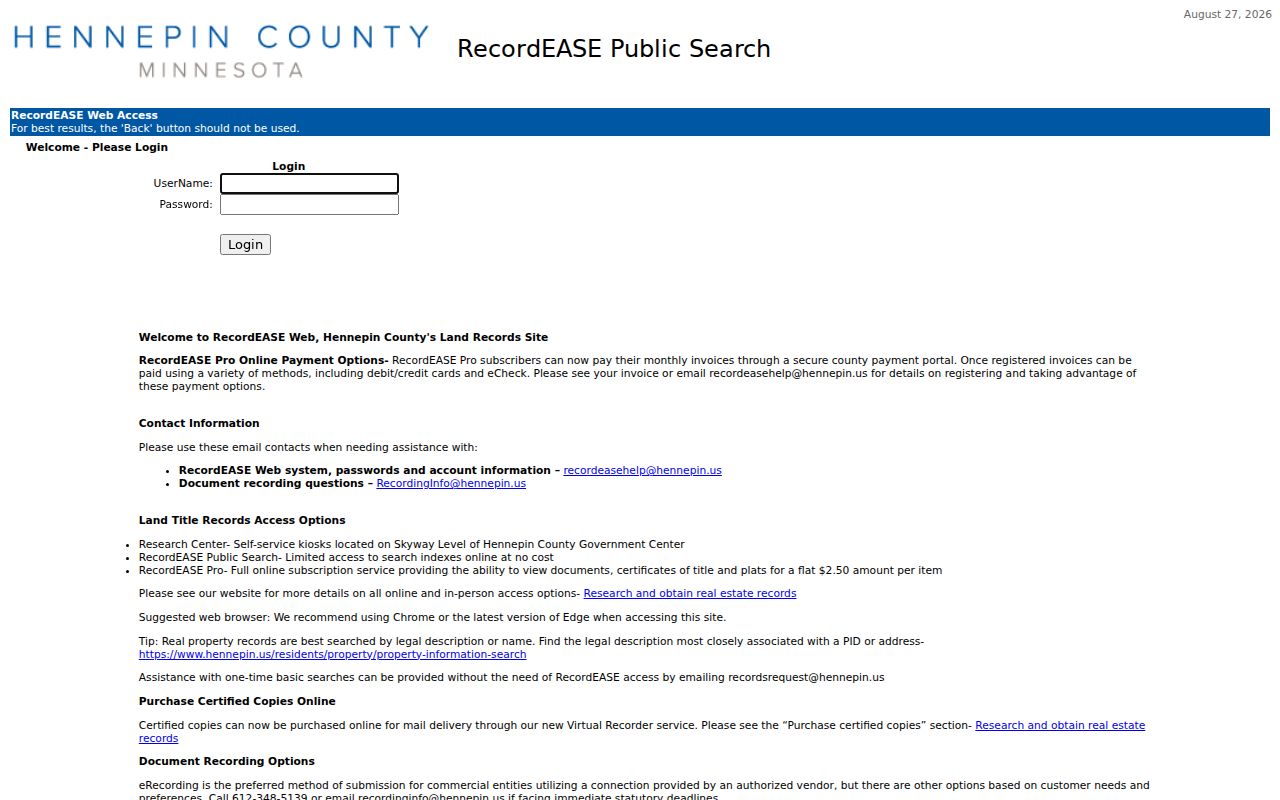
Hennepin makes public research kiosks available at the Government Center Skyway Level. RecordEASE Pro provides subscriber access to document images, certificates of title, and plats for the county’s stated $2.50 per item. For an identified document, the recorder’s mail route, staff, or a document-copy request can supply the next step. The point is to follow the instrument, not to assume an index name identifies a former household.
Crystal Previous Residents Through a Deed Chain
A deed chain follows the recorded relationship to a parcel backward. It does not make a claim about occupancy. A transfer can name a trust, lender, estate, entity, or an owner who lived elsewhere. Describe the result narrowly as a party named in an instrument, a grantor, a grantee, or a person associated with the parcel unless a dated directory or another independent source establishes a home address.
- Search the current Crystal address in PINS and record the PID and complete legal description.
- Search that legal description and the returned parties in RecordEASE, then note instrument type, number, recording date, and every party as displayed.
- Open, order, or inspect the instrument when the legal text is needed. Compare its legal description and parcel references with the prior transfer.
- Repeat the documented link backward, retaining each document number rather than relying on an address alone.
- When web access stops, use the public kiosk, recorder assistance, a paid document route, or the mail-copy process.
- Grantor and grantee
- The grantor transfers an interest named in an instrument. The grantee receives the stated interest. Those roles do not prove that either party occupied the property.
- Chain of title
- A sequence of recorded instruments connected by legal description and parcel references, used to follow land interests through time.
- Legal description
- The recorded land description, often using addition, lot, and block. It is stronger than a street address when a street name or number has changed.
Hennepin states copy fees of $1 per page for noncertified copies and $10 for certified copies. Plats are $10 noncertified and $15 certified. Mail requests go to County Recorder/Registrar of Titles, Attn: Document copies, Hennepin Government Center, 300 South Sixth Street MC 074, Minneapolis, MN 55487; the county says that route takes checks payable to Hennepin County Recorder and does not accept credit cards. A property owner may request a free electronic deed or certificate copy through recordsrequest@hennepin.us.
Crystal Address History in Permits
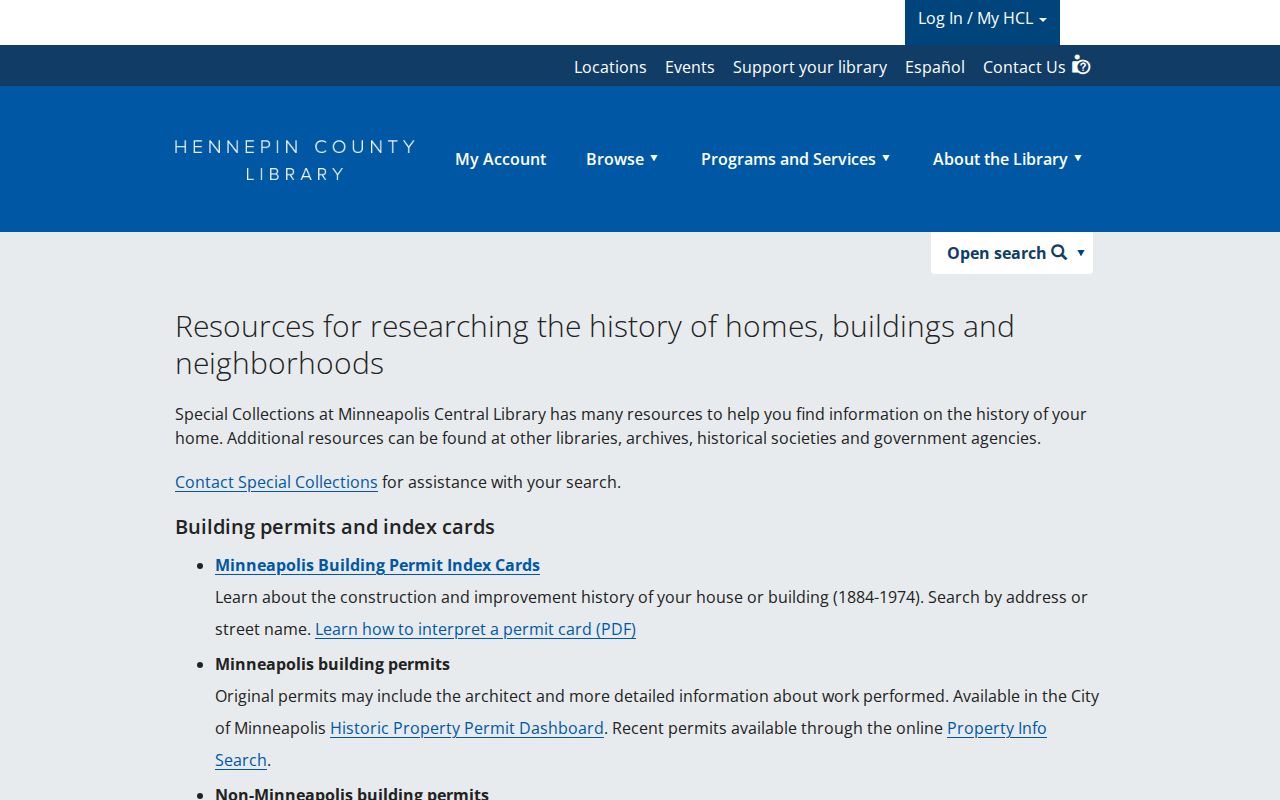
The Hennepin County Library Researching Homes guide pairs plats, directories, newspapers, maps, and permit questions with an address. It cautions that Minneapolis permit cards do not substitute for Crystal research. For Crystal, start with the city’s ePermits search, which can search by address or permit number and may display inspection results or scheduled inspections. Its public coverage is primarily single-family residences, and most commercial records are not online except commercial electrical.
The library’s house-history guide lays out the address, permit, plat, directory, and newspaper sources that can connect a Crystal house to a date.
A pre-digital permit may require Community Development or the City Clerk. Request the address, approximate year, permit type, and preferred format. Crystal’s public-record route asks for a clear and specific request; the city states that public information is generally supplied within 10 business days, inspection is free, copies are generally $0.25 per page, and additional search or retrieval costs may apply. The city need not create a record that does not exist.
Crystal Previous Residents in Two Directories
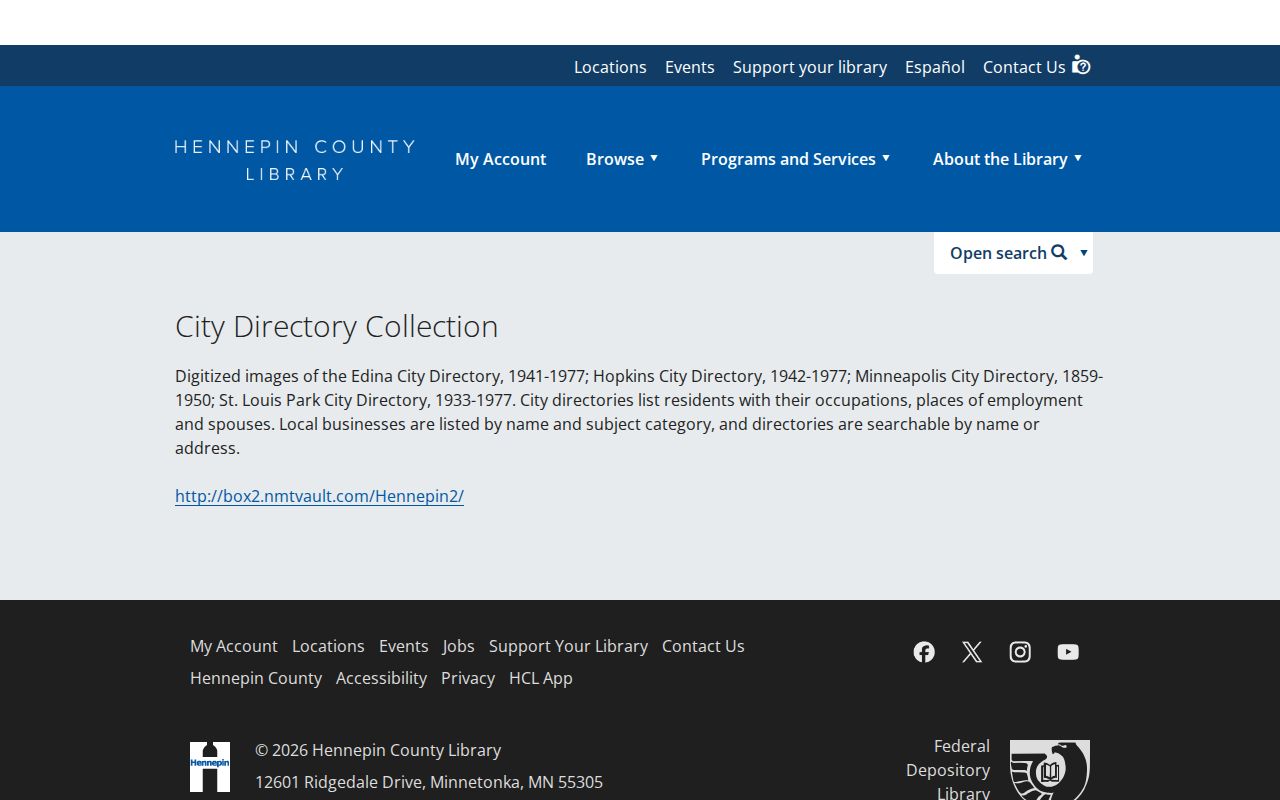
Hennepin County Library’s City Directory Collection holds Crystal volumes for 1969–1983 and Robbinsdale–Crystal volumes for 1937–1981. The overlap is a valuable local clue. An address or name can appear in one collection, both, or neither because the directory title, geography, or indexing changed. A vanished entry is not by itself evidence of a move or death.
The HCL city-directory collection is the official doorway to the Crystal and Robbinsdale–Crystal runs.
Use the digitized Hennepin2 directory viewer and HCL’s Directory Search Tips together. Searches are case-insensitive exact text unless wildcards are used; `*` matches any characters and `?` matches one. Abbreviations, ditto marks, spouse parentheses, and b/r/h resident prefixes can change a result’s meaning, so confirm the page image and preserve its year and image number.
Crystal Previous Residents in the Archive
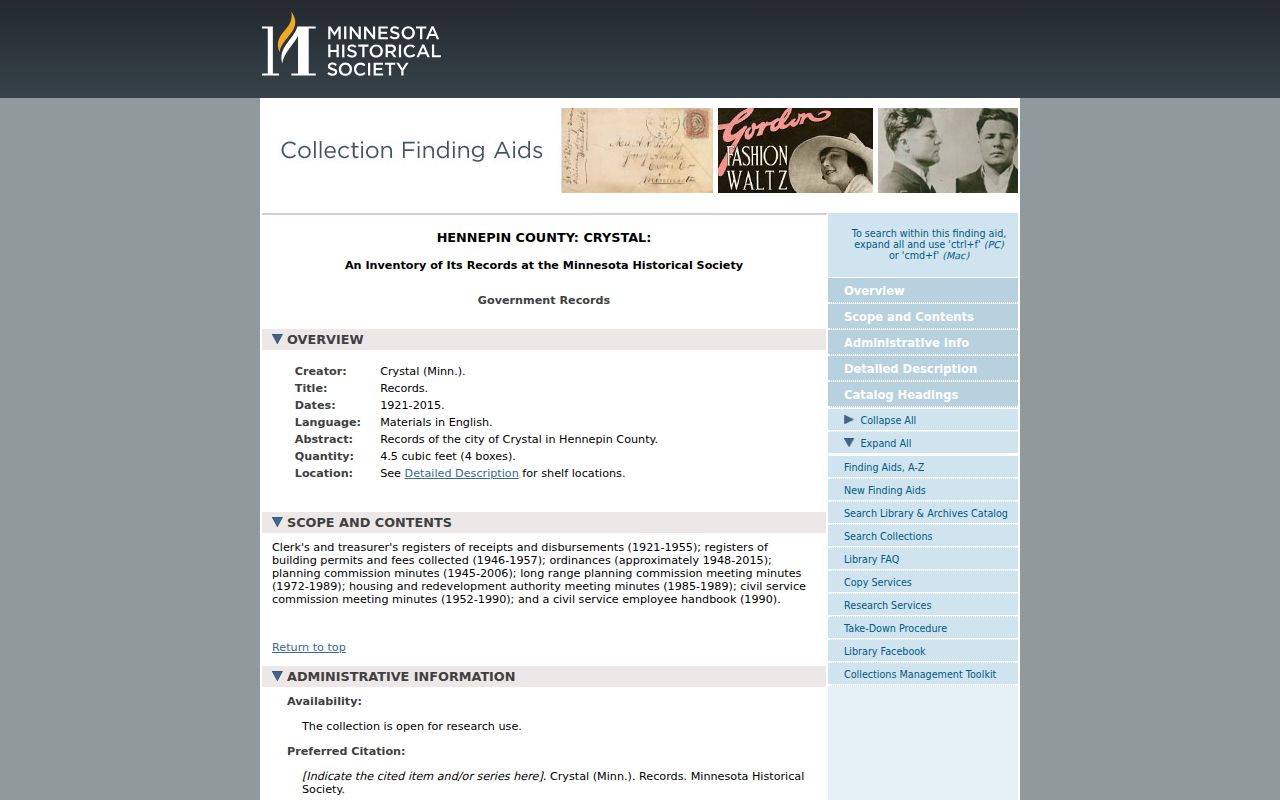
The Minnesota Historical Society finding aid for City of Crystal records lists 4.5 cubic feet in four boxes, open for research, dating from 1921–2015. It identifies building-permit and fee registers for 1946–October 1950, November 1950–1953, and 1954–April 1957, along with ordinances, planning minutes, and administrative records. These are targeted address-history sources, not a list of people who lived in every house.
The City of Crystal records finding aid supplies series dates and access detail before an archive request is made.
Use the listed accession, box, or series language in a request. For additional historical context, the Hennepin History Museum archives accept research appointments at research@hennepinhistory.org and hold maps, clippings, directories, photographs, yearbooks, and related collections. The research file did not establish that every Crystal address has a Sanborn sheet, so ask for the municipality and year rather than promising map coverage.
Crystal Previous Residents and Former Streets
Address continuity is a local research problem. Crystal history identifies old Crystal Lake Avenue as present West Broadway, but the exact date of every citywide street-name or numbering change was not located. Search both forms, including relevant directional or abbreviated versions, and keep the first dated source that links them. A plat, directory, deed legal description, newspaper, or dated map is needed before merging two similar addresses.
Older files can also use Crystal Lake Township, Robbinsdale, Minneapolis, Golden Valley, or New Hope rather than today’s Crystal label. Crystal reorganized in 1911 after earlier boundary changes. For a pre-1911 question, test the date and jurisdiction before deciding the record is missing. This keeps an old address from being forced into a present-day city label without evidence.
Note: Record the source’s spelling, jurisdiction, date, and limitation before normalizing an old Crystal address into a current form.
Crystal Past Households Need Two Sources
A deed trail and a household trail are not the same. Directories can place a dated household association at an address, while a recorded instrument identifies parties to land activity. Newspapers, city packets, permit materials, maps, and archival records can provide a second dated check when a question involves who lived here before. The collections themselves are described in the Crystal city directory, where title, year, and image-reading details can be reviewed.
Use only the narrow fact that a source supports. A directory hit is a historical association, not proof of a present address. A person named in a deed or permit may be an owner, applicant, contractor, representative, or other party. Safe at Home substitute addresses and protected records remain protected, even if another source appears to point elsewhere.
Lawful use. Crystal previous-resident research is suited to family history, heir questions, and house history. Do not use an address trail to watch, contact, harass, or harm a living person; Minnesota law protects against stalking and harassment.